Yazan Sarayrah on IRTH-TRONIC, Arabic Maqam and Reimagining Electronic Music Through Heritage


For many artists, heritage becomes something to reference. For Yazan Sarayrah, it forms the foundation of everything he creates.
The Jordanian producer, composer and live performer has spent years developing a musical language that places Arabic maqam, Bedouin traditions and Nabatean poetry at the centre of contemporary electronic music. Rather than borrowing from those influences as stylistic flourishes, his new album, IRTH-TRONIC, treats them as the core building blocks of its compositions, creating a body of work that feels both deeply rooted and unmistakably forward-looking.
That connection stretches back long before electronic music entered his life.
"Many memories come to mind, but the ones I remember most are our family gatherings," he recalls. "My older brother would pick up his Oud and start singing, and everyone would immediately join in. Then my other brother would bring the Tabla, and before long the whole family would be singing Khaleeji and traditional Bedouin songs together."
Those moments became his earliest musical education, alongside memories of his late father writing Nabatean poetry and his grandmother quietly chanting Hjeni while carrying out everyday tasks.
"I was always curious about music," he says. "I'd sneak into my brothers' room to play their instruments whenever they weren't around."
Despite that upbringing, electronic music wasn't an obvious destination. Coming from a background of live bands and traditional instrumentation, it initially felt disconnected from the world he knew.
"That changed when I started going to raves," he explains. "That's when I really felt the energy, the sound design and how the groove pulled everyone together. Around that time, a friend introduced me to Boards of Canada, and that completely changed my perspective. I realised electronic music could go so much deeper than just the dancefloor."
Rather than leaving his musical roots behind, that discovery encouraged him to bring both worlds together.
"Electronic music is so different from our traditional Bedouin music, and that distance is what made me see it as an opportunity to bring them together."

That philosophy became the driving force behind IRTH-TRONIC. The album explores identity, belonging and cultural memory while challenging the way the region is often represented through Western perspectives.
"The last few years really opened my eyes," he says. "I started to see how certain stereotypes shape the way this region is perceived. Our culture, our poetry and our music are so deep, full of ancient wisdom and real richness that everyone could benefit from experiencing."
He is careful not to romanticise those traditions, acknowledging that every culture evolves and carries its own complexities. Instead, IRTH-TRONIC represents an attempt to contribute to that evolution rather than preserve heritage as something frozen in time.
"It became a statement. This is who we are, and this is what we stand for. It's my humble attempt at giving our land a voice in the field that I know best, music."
The album also reflects a personal homecoming. After years spent travelling and exploring different musical directions, Sarayrah found himself returning to the landscapes and traditions that first shaped him.
"This wasn't really a search for identity," he explains. "It was more like, after years of travelling and exploring different sounds, IRTH-TRONIC became the moment where I came home."
That journey extends into the album's musical language. By building compositions around Arabic maqam rather than simply adding traditional melodies to Western structures, Sarayrah unlocks an entirely different melodic vocabulary.
"What I appreciate about Arabic maqamat is that they give more melodic possibilities," he says. "Having more notes within the octave creates much wider phrasing possibilities. A small detail can completely change the feeling a melody delivers."
Integrating those systems into modern production wasn't always straightforward. Most software isn't designed for microtonal harmony, forcing him to develop his own workflow.
"At the beginning, I had to rely almost entirely on my ears," he explains. "Later I started creating custom tuning files for instruments like Diva and Serum so I could work more naturally."
His analogue instruments required similar adaptations.
"With my guitar I use quarter-tone bends, and with my analogue synths I use pitch bends to reach those microtones."
Landscape plays an equally important role throughout IRTH-TRONIC. Rather than simply inspiring the artwork or concept, Jordan's geography directly influences the way the music moves.
"The environment has a huge impact on what people perceive as musical," he says. "The sounds that surround us become part of the way we express ourselves."

He points to the contrast between northern Jordan's greener landscapes, where wind instruments dominate traditional music, and the southern desert, where the Rababa reflects a harsher, more open sonic character.
"The vastness of the desert also changes your perception of time," he explains. "Rhythm isn't always about fixed points. It's about movement, space and the pace of the performer."
Those ideas emerge throughout the album in unconventional time signatures, open arrangements and expansive atmospheres that mirror the physical landscapes which inspired them.
Sarayrah is equally conscious of avoiding the exoticisation that often surrounds artists working with regional traditions. Authenticity, he says, comes through constant dialogue with the people who have preserved those art forms for generations.
"I was always checking with my brother and my mum to make sure I stayed true to the meaning and delivery," he says. "Even if you grow up within that culture, you have to keep verifying with the people who know the tradition best."
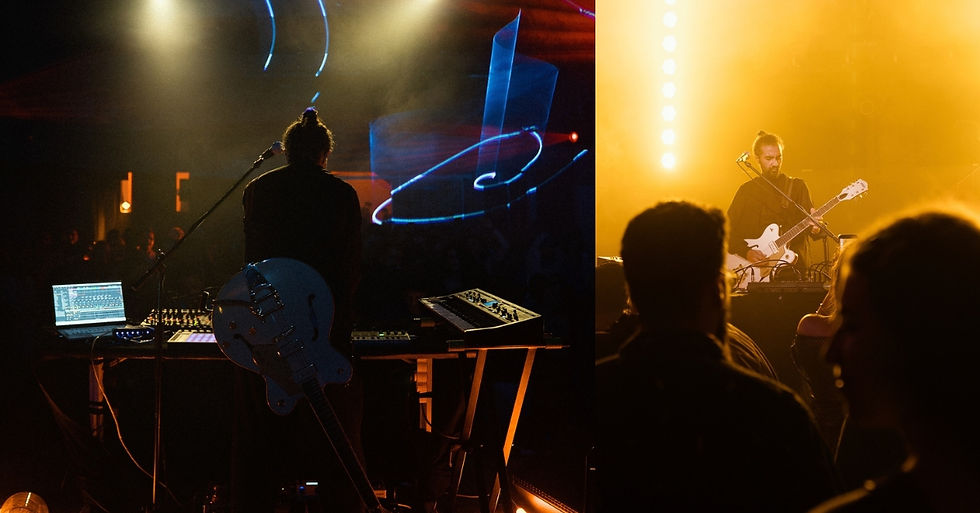
That philosophy extends naturally into his live performances, where voice, guitar, analogue synthesis and real-time improvisation transform IRTH-TRONIC into something that evolves from one performance to the next.
"The live show is where IRTH-TRONIC comes to life," he says. "I know the direction of the journey, but I allow the details, transitions and emotions to change depending on the space and the moment."
Ultimately, Sarayrah hopes the project encourages a new generation of Arab electronic artists to see heritage as something that continues to grow rather than something confined to history.
"I believe heritage is alive," he says. "Traditions need to grow so they stay relevant. I hope this album reminds people to look inward and value what we already have, because there's so much beauty in our shared heritage."
As IRTH-TRONIC demonstrates, electronic music doesn't need to borrow identity from elsewhere. Sometimes the most progressive ideas come from rediscovering the stories, sounds and traditions that have been there all along.


