Visions of Light on ‘Mycelium Bloom’, Creative Connection and Letting the Music Find Its Own Path


For Visions of Light, finishing an album does not seem to provide much reason to stop making one.
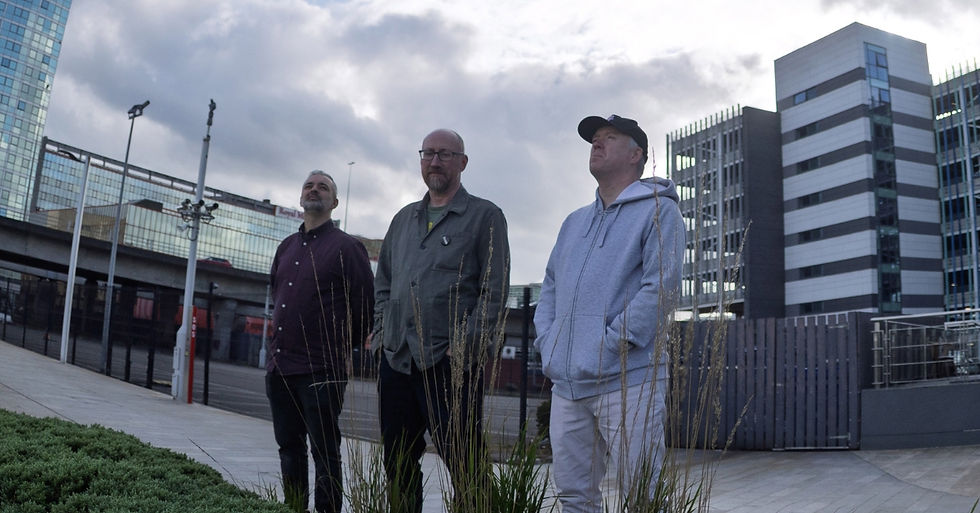
The Belfast trio of Simon Sheldon, Muzka and Dan Dub Lounge only introduced their full-length vision with 2025 debut The Mandala Vortex, before returning with Dedications, an EP that dismantled records by NJOI, New Order, Liquid, De’Lacy and Underworld and rebuilt them through the group’s Balearic and dub-informed language.
Now, second album Mycelium Bloom pushes considerably further outwards. Their familiar deep bass, spacious electronics and live instrumentation remain, but acidic details, psychedelic textures and increasingly strange atmospheres have begun spreading through the spaces between them.
The speed of that evolution is not the result of a particularly prolific album campaign. Visions of Light simply never stopped.
“We operate as a continuously producing trio, driven by our shared love for creating and sharing ideas,” they explain. “We were completing the bones of our next project before the previous one was even released.”
“We never stop.”
That constant exchange provides Mycelium Bloom with both its name and its underlying philosophy.
Mycelium exists beneath the surface as an interconnected fungal network, and the trio saw parallels with a creative process built around ideas continually travelling between them. More broadly, the title reflects their belief in reconnecting with one another and the natural world at a point when they see increasing social disconnection around them.
“We likened our collaborative process – where we travel back and forth, editing each other's input across various styles – to underground networks and natural mycelium systems that create life in bloom.”
Where The Mandala Vortex represented a journey through “fractal beauty”, its successor is about “connecting with each other and nature via a network of pulses, rhythms and light”.
It would be easy to read the album’s deeper psychedelic character as a deliberate change in direction. The reality is considerably less calculated.
Visions of Light have operated from the beginning without fixed rules, genre targets or individual egos dictating the destination. One member might establish the bones of a track before passing it onwards, while several other ideas remain in circulation simultaneously.
“We pass ideas back and forth to add, reduce, chop and change parts, allowing tracks to be completely transformed from what they originally sounded like.”
The stranger electronics, acidic details and psychedelic edges of Mycelium Bloom emerged through that process rather than being imposed upon it.
“The Mycelium network grew, and we followed.”
That willingness to transform existing ideas had already been tested from another angle on Dedications. Taking culturally significant dance records and translating them into Visions of Light’s slower, spacious world required the trio to consider what actually survives when the familiar architecture of a track is removed.
The exercise taught them about “how listeners connect with songs in different contexts” and how a musical story can be retold while transporting its audience somewhere entirely different.
They initially saw little direct connection between that project and Mycelium Bloom. Looking back, the relationship is clearer.
“Pushing past initial doubts by collaborating and combining our ideas helped everything click into place, without us realising that this also impacted the way Mycelium Bloom turned out. Everything is connected.”
That final phrase could almost function as the album’s manifesto.
Connection extends beyond the three musicians themselves to the places in which their ideas originate. Visions of Light do not exclusively create together in one studio. Tracks can begin in a winter cabin in Poland, on a train, in a back garden, a bedroom studio or somewhere deliberately removed from everyday life.
Those environments inevitably find their way into the music.
“Experimentation and familiarity combine to hopefully create something of interest that allows the listener to switch off and join our narrative for a few minutes.”
Tracks such as ‘Split The Scene’, ‘All The Best Things’ and ‘Holding Jupiter’ make that invitation particularly vivid. Rather than simply moving through arrangements, they establish environments of their own, using low-slung rhythms, deep bass, guitars and electronics to create the sensation of being somewhere rather than merely listening to something.
On ‘Perfect You’, the network expands again.
Actor Richard Dormer contributes words and an emotive spoken performance, first shared with the trio in Ibiza, while Luis Vilca adds flute. Rather than placing those contributions on top of an already completed production, Visions of Light stripped away beats and complexity to create room around Dormer’s voice.
The approach says something important about how they view collaboration.
“We think building connections through other artists is as important as building connections with listeners, helping to extend the reach of the Mycelium Network.”
The same philosophy has increasingly moved Visions of Light beyond the studio.
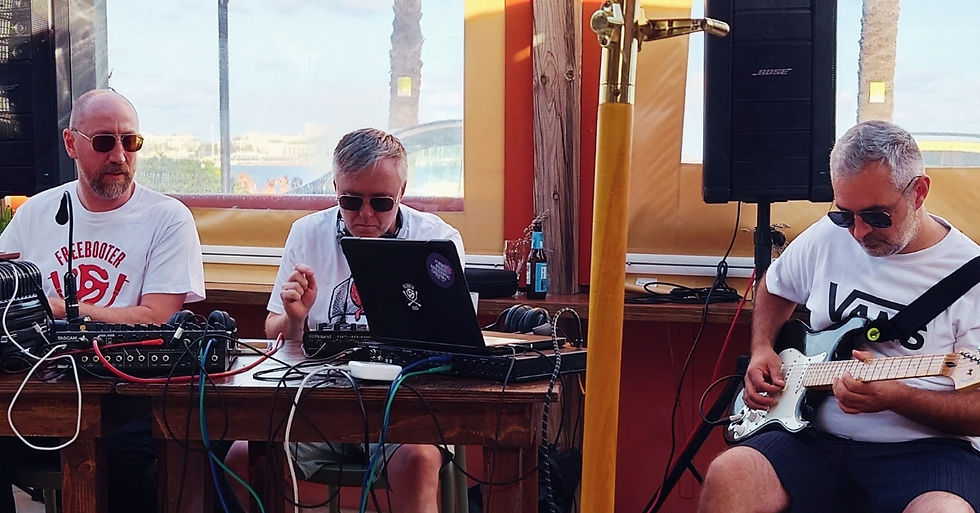
A 75-minute sunset performance at Word of Mouth in Santa Eulària proved particularly significant. With the ocean behind them and friends gathered in front, Sheldon and Dub Lounge played live keys, guitar and melodica while Muzka filled the spaces between with carefully selected samples.
There was no rigid plan.
Instead, the set unfolded according to many of the same principles as their records: different elements interacting in real time, leaving enough space for the unexpected.
“The combination of the ocean backdrop, the crowd of friends and our combined live approach […] unfolded perfectly and showed us how meaningful our live dynamic can be.”
For music capable of conjuring Ibiza sunsets and imaginary psychedelic landscapes, Visions of Light nevertheless remains deeply connected to Belfast.
All three members arrived at the project carrying different histories within the city’s musical culture. Electronic music, dub reggae, hip-hop, drum & bass and rock bands all sit somewhere in their collective past, alongside connections to local nightlife and community projects including Plan B and 5th Element.
“Our diverse connections to Belfast […] heavily influence our work and reinforce our belief that good things grow from strong connections.”
Once again, the language returns to networks.
That might ultimately be what distinguishes Visions of Light more clearly than any genre description could. The Mandala Vortex, Dedications and Mycelium Bloom have progressively established a recognisable identity, yet the trio seem increasingly uninterested in defining the music itself.
It is an apparent contradiction that suits them.
Rather than protecting a formula, they continue drawing from a substantial backlog of ideas while introducing new instruments, effects, sonic palettes and visual elements. Each member can propose another route, and the collective decides whether it belongs.
“We want to keep surprising ourselves and our listeners.”
There is no predetermined destination attached to that philosophy, which is precisely the point.
From three musicians exchanging unfinished ideas to collaborators entering the process, environments leaving their imprint and audiences completing the connection, Mycelium Bloom presents Visions of Light less as a fixed band than a continuously expanding network.
Wherever that network spreads next, they seem perfectly happy to follow it.
“Wherever we end up next, we will embrace it and be thankful to be there.”
Grab your copy of ‘Mycelium Bloom’ here.


